


















Last updated: Monday, July 20, 2026
If you have a strong prescription for eyesight, you are familiar with the routine. You choose a fashionable frame from the display case. After a couple of weeks, you get your personalized glasses. Then the lenses arrive, and suddenly the frames look much bulkier than expected.
The edges stick out like the bottom of an old soda bottle. Your new glasses keep sliding down your nose. They feel heavy, pinch behind the ears, and can change the way your face looks through the lenses. Your eyes look noticeably altered in size to anyone looking at you. This common problem is why high-index lenses have become a major improvement for modern eyewear users.
But what does the high index lenses mean for the average wearer? In simple terms, high-index lenses bend light more efficiently than standard lens materials, allowing them to be thinner and lighter. They transform strong prescriptions into stylish, lightweight, and ultra-stylish glasses.
Selecting the right eyewear material is crucial for daily comfort, visual field, and confidence. With strong correction needs, traditional options are ineffective. For people with strong prescriptions, they are often more than a convenience. They can be a necessity for everyday comfort and clear vision.
Understanding the Different Types of High Index Lenses
When shopping for new eyewear online or at an optical shop, you will experience several index numbers. These numbers simply represent the refractive index of the material. A higher number means the material bends light more efficiently. This efficiency allows lenses to be made much thinner.
If you have a mild to moderate prescription, you might wonder: what is 1.61 high index lenses? These are entry-level thin lenses designed to replace basic, bulky plastic. They are roughly twenty percent thinner than standard options.
These lenses provide excellent optical clarity at an affordable price point. They are perfect for reading glasses or moderate computer work prescriptions. High-index lenses offer a great balance of value and a thinner lens profile for lower prescription ranges.
1.67 High Index Lenses: Meaning and Uses
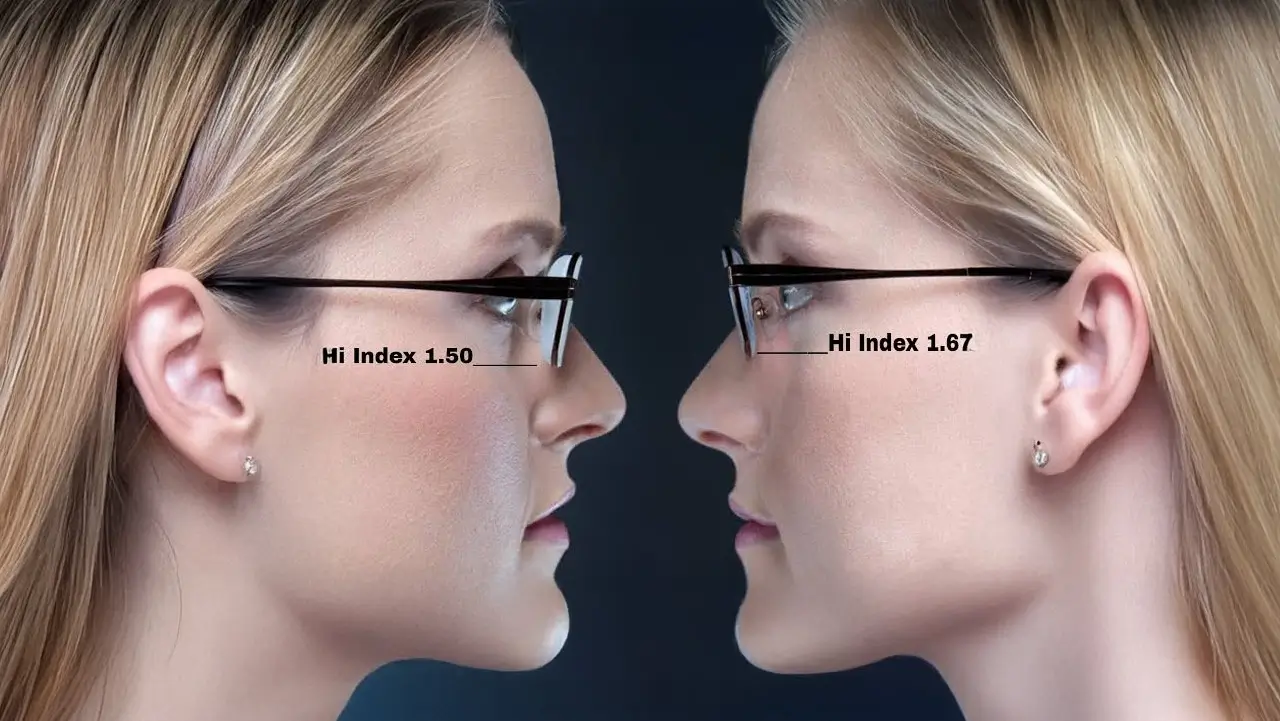
Stepping up the scale brings us to the 1.67 higher-index option. The main advantage of 1.67 high index lenses is their ability to reduce lens thickness for stronger vision corrections. These lenses are around 35% thinner than those made of traditional plastic. Those with strong astigmatism and high nearsightedness will find these excellent. These high-index lenses help ensure the frames you choose will look classy, have a balanced structure, and precisely suit your face.
1.74 High Index Lenses: The Ultra-Thin Choice
For individuals with demanding prescriptions, 1.74 high-index lenses represent the thinnest commonly available plastic lens. They are ultra-thin, remarkably lightweight, and cut down the bulk by up to half compared to basic lenses. These lenses eliminate the thick edge profile. They look exceptionally elegant in almost any frame styling you choose to wear, giving you a completely natural appearance.
1.90 High Index Lenses: Max Density Glass
The rarest option is the 1.90 high-index lenses, which are crafted strictly from specialized mineral glass. These are the highest-index glass options reserved for extreme prescriptions. They are heavier than plastic, but because they are made of glass, they are incredibly resistant to scratches and offer sharp, clear images. They require careful frame pairing to ensure they do not pinch your skin during regular physical activity.
High-index Lens Profile Overview
Lens Index Type | Thickness Reduction | Best Prescription Range | Material Base |
1.50 Standard | 0% (Baseline) | Plain to +/- 2.00 | Standard Plastic |
1.61 High Index | ~20% Thinner | +/- 2.00 to +/- 4.00 | Advanced Polymer |
1.67 High Index | ~35% Thinner | +/- 4.00 to +/- 6.00 | Premium Polymer |
1.74 High Index | ~50% Thinner | Above +/- 6.00 | Ultra-Dense Resin |
1.90 High Index | Maximum Flatness | Extreme Prescriptions | Mineral Glass |
Ultimate High Index Lenses Comparison
The selection of the right material depends on the comparison of these advanced materials with traditional optical materials. With a proper high-index lens comparison, you can find the best combination of weight, clarity, and durability to suit your everyday life.
High Index Lenses vs Regular Plastic
Standard plastic lenses are cheap to make but much thicker. When correcting a strong prescription, regular plastic becomes incredibly thick at the outer edges. This creates a bulky look that spills out of the frame line. High-index materials significantly reduce lens thickness.
Polycarbonate Lenses vs High Index
Polycarbonate is notable for its impact resistance, which is ideal for sports and safety applications. However, it may have slight chromatic aberrations or fuzzy colors in the corners and edges of your vision. High-index materials provide better optical clarity throughout the lens. They give you sharper peripheral vision while keeping the physical profile thinner and lighter for extended wear periods.
1.67 vs 1.74 High Index Lenses
The choice between 1.67 and 1.74 comes down to your specific prescription numbers. If your prescription is above a minus six, stepping up to 1.74 is highly recommended. The 1.74 option removes that remaining edge thickness. It gives you the flattest, most natural look possible across your entire field of view, minimizing facial distortion completely.
Material Performance Metrics
Performance Attribute | Regular CR-39 Plastic | Polycarbonate Safety | Premium High Index |
Optical Clarity (Abbe Value) | High (58) | Low (30) | Medium to High (32-42) |
Impact Resistance | Low | Extremely High | Moderate to High |
Edge Thickness Profile | Very Thick | Moderate | Extremely Thin |
Weight Distribution | Heavy for High Rx | Light | Ultra-Lightweight |
UV Protection | Requires Coating | Built-In | Built-In |
How Much Do High Index Lenses Cost?
Quality optical engineering requires precision manufacturing, which naturally influences the final retail pricing. The overall high-index lens price depends heavily on your specific index selection, your prescription strength, and any custom coatings you choose to add to the surface.
When analyzing how much are high index lenses cost, standard entry-level options might add a modest fee to your base package. However, thinner premium lenses can cost significantly more. It is because of the advanced manufacturing equipment required to shape the dense material.
If you are wondering how much high-index lenses cost on average, they range from one hundred to several hundred dollars, depending on the complexity of your corrective prescription.
Are High Index Lenses Worth It?
If you spend a lot of time in glasses, you will find that high-index lenses are truly worth it. They remove the pressure on the nose, and they also look after the chafing that can happen behind the ears from heavy eyewear.
If you look at the cost over the years of wear, the benefits get clearer. The advantage of the lighter lens is less skin irritation, fewer tension headaches, and improved spatial awareness. They can transform your glasses from something you tolerate into something you barely notice wearing. Protecting your vision with the best available technology is always a wise investment.
Where to Buy Premium High Index Lenses
Finding a reliable supplier for advanced optical products is essential for a great result. Many standard retail shops charge higher prices on thin materials. They often lack the specialized laboratory equipment needed to cut high-index blanks with perfect accuracy, leading to errors in your visual alignment.
When deciding where to buy 1.74 high index lenses, buying online from a reliable provider is often the smartest route. Online platforms avoid traditional retail overhead costs completely. They pass those massive structural savings directly down to you. This allows you to get premiums, ultra-thin protective eyewear at a fraction of standard brick-and-mortar pricing.
Buying online also grants you access to centralized digital manufacturing laboratories. These facilities specialize in handling complex prescriptions with consistent results. There is no need to choose from a small selection at a small local store. On the other hand, you can access a wide range of frames that are highly durable and built specifically for the mounting of advanced compressed lenses.
Why Choose EyeWEB for Your Next Pair of High Index Lenses
Strong prescriptions don't have to be difficult or costly to figure out. At Eyeweb, we use advanced digital lab technology to custom-cut thin high-index lenses for strong prescriptions. Our modern surfacing machinery shapes dense high-index polymers with absolute geometric precision, tailoring them perfectly to your chosen frame shape.
Our digital cutting process eliminates the heavy, old-fashioned "bug-eye" effect. It ensures your eyes look perfectly natural to anyone looking at you. This precision engineering also ensures maximum frame compatibility. It allows you to select stylish, modern frames that would normally be incompatible with thick, traditional lenses.
You are no longer restricted to thick plastic borders just to hide your lens edges. Choosing the right lenses can be difficult, but we make it easier for you. We verify every single prescription millimetre before shipment. When choosing a provider, look for one that focuses on quality, transparent pricing, and improved comfort.